Rocket Fuel for Growth or Costly Distraction?
Cory Mosley
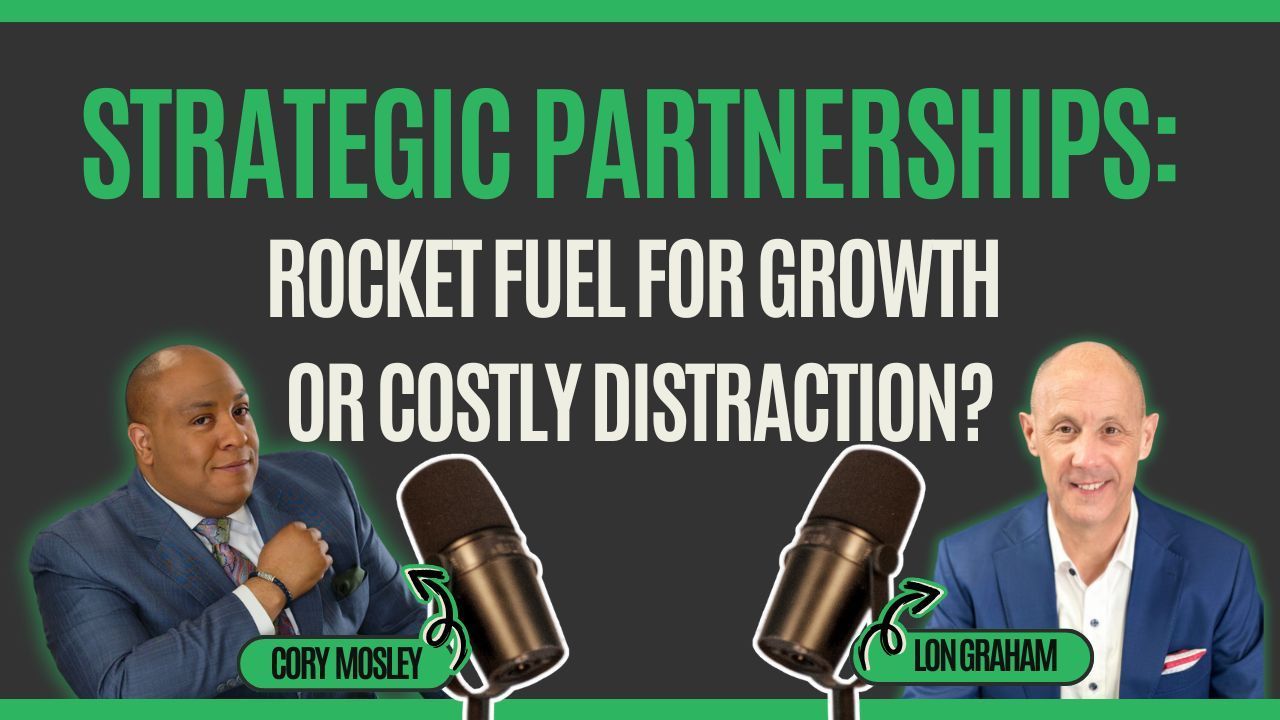
In this episode of the Grow Business Podcast, Cory Mosley and Lon Graham unpack a truth most business owners learn the hard way:
Strategic partnerships don’t fail because the idea was bad.
They fail because the expectations were vague.
And in 2026, vague is expensive.
Everybody wants to “collaborate.” Everybody wants to “get in front of your audience.” Everybody wants to “partner.”
But a partnership that isn’t tied to a clear business outcome isn’t strategy.
It’s speculation.
This conversation breaks down how to evaluate partnerships with the same discipline you’d use to evaluate a hire, an investment, or a market expansion—because that’s what partnerships are: a leverage play or a momentum killer.
You don’t need more opportunities.
You need better filters.
In this episode:
- When to pursue partnerships: only with a clear growth objective
A real partnership solves a specific growth problem. It accelerates revenue, expands reach, or builds credibility faster than you could do alone.
If you can’t clearly define what it’s supposed to do for the business, it’s not strategic—it’s entertainment. And entertainment is expensive when you’re trying to grow. - Defining success is the first principle of leadership
Cory makes it plain: defining success is the number one principle for success in sales leadership.
Because if you don’t define success, you can’t measure progress.
And if you can’t measure progress, you can’t manage the partnership.
Partnerships need KPIs, timelines, and a clear “win condition.” Otherwise you’re stuck in the most dangerous phrase in business:
“Let’s just see what happens.” - Avoid partnerships when roles, ownership, and control are vague
Ambiguity feels friendly at the beginning.
But it becomes expensive at the end.
If decision-making authority isn’t defined, execution turns into friction. If ownership conversations keep getting avoided, the partnership becomes a slow-motion conflict you can see coming but don’t stop.
And if you don’t talk about the exit before you start?
You’ll eventually negotiate it while frustrated—and that’s when emotion gets expensive.
- Say yes only when the partner has proven execution power
Big talk is not a business asset.
You’re not looking for ideas. You’re looking for execution, infrastructure, audience, and follow-through.
Cory drops a line that should be written on the wall of every business owner who’s ever carried a “partnership” alone:
A partner without execution isn’t a partner. They’re a dependent.
If you’re expected to be the operational backbone while someone else brings “vision,” you’re not partnering. You’re adopting.
- Avoid partnerships that distract from your core growth engine
Not every profitable opportunity is worth your attention.
Some partnerships generate revenue while quietly reducing profitability—because they pull you away from what your business already does best.
If the partnership forces you into a new message, a new model, or a new market that doesn’t align with your positioning, you don’t have a growth strategy.
You have operational drag.
Growth doesn’t come from doing more things.
It comes from doing the right things better.
- The smartest partnerships are testable before they’re permanent
The best partnerships don’t start with big promises.
They start with small proof.
Pilot projects. Short-term agreements. Clear review points. Revenue share before equity. One client before “we should build a company together.”
Because permanence should be earned—not demanded.
The Filter That Changes Everything
If the partnership doesn’t do three things, it’s not strategic:
- Accelerate growth
- Protect focus
- Reduce risk
Otherwise, it’s a distraction dressed up as leverage.
Audit your current partnerships. Look at the ones you’re considering. Ask yourself one honest question:
Is this fueling growth—or draining momentum?
Because the right partnership feels like leverage.
And the wrong one feels like a second job.
Plus: Sponsored by Pecan Jacks Ice Cream and Candy Kitchen—now franchising nationwide. With nearly $1M in average unit volume, this is a sweet opportunity you don’t want to miss. Learn more at pecanjacksfranchise.com.
Credits:
- Hosted by: Cory Mosley, Business Growth Strategist
- Co-Hosted by: Lon Graham, Voice of Reason
- Produced by: Willie H.
Share Post
Similar Posts