From Street Smarts to Smart Hires: How to Build a Scalable Business Team

Cory Mosley
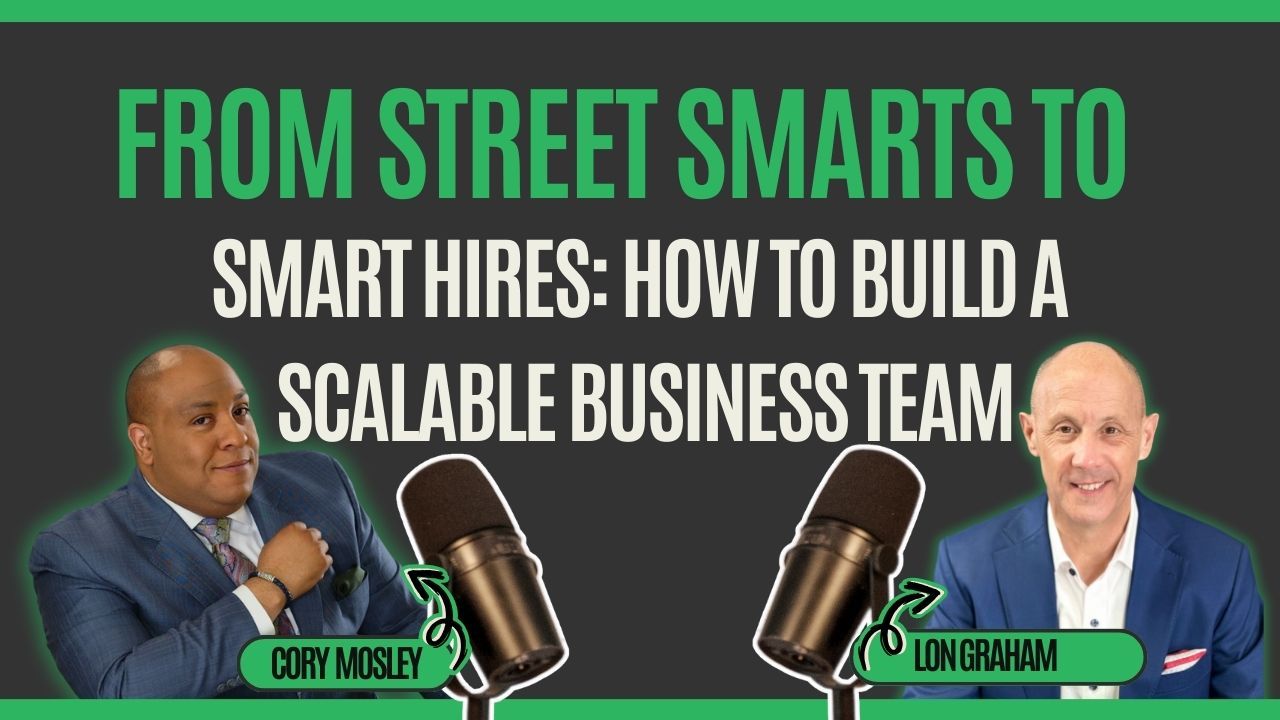
In this episode of the Grow Business Podcast, Cory Mosley and Lon Graham dig into one of the most overlooked growth barriers in business: your hiring habits—and why they might be holding you back in 2026.


This conversation goes beyond simple recruiting tips. It’s about rethinking how you evaluate people, structure roles, and scale your team so that you can grow with clarity, confidence, and real leverage—not frustration, burnout, or constant rehiring.


If you’re serious about building a business that scales instead of stalls, it’s time to stop hiring based on comfort and start hiring based on capability.


Inside this episode:

  • Why likability isn’t a qualification
    Just because you get along with someone doesn’t mean they’ll grow your business. Chemistry matters — but capability wins.
  • How “mini‑me” hires create blind spots
    Clones don’t challenge your thinking — and teams without strategic tension struggle to adapt.
  • The danger of hiring for hours instead of outcomes
    Paying for time gets you time. Paying for outcomes gets you results — especially with contractors and freelancers.
  • Why fractional leaders are a 2026 superpower
    Access strategic experience without the full‑time cost — and use it to build systems that scale.
  • The real cost of founder bottlenecks
    If you are the only one who can approve decisions, growth stops with your calendar.
  • What it means to hire for the business you’re building
    Stop patching today’s problems and start recruiting for tomorrow’s opportunities.

Whether you’re a founder, CEO, or growth‑minded business leader, this episode will challenge how you think about people, roles, and leverage — and help you hire for growth, not guesswork.


Plus: Sponsored by Pecan Jacks Ice Cream and Candy Kitchen—now franchising nationwide. With nearly $1M in average unit volume, this is a sweet opportunity you don’t want to miss. Learn more at pecanjacksfranchise.com.


Credits:

  • Hosted by: Cory Mosley, Business Growth Strategist
  • Co-Hosted by: Lon Graham, Voice of Reason
  • Produced by: Willie H.

Share Post

Similar Posts

By Cory Mosley March 11, 2026
Before a customer calls, fills out a form, or walks into your business, they’ve already made a decision about you. And that decision usually has nothing to do with how good you are. It’s based on what they see. In today’s market, buyers validate before they initiate. That means your website, reviews, branding, and even the way you communicate are doing “the interview” long before you ever get a chance to explain yourself. In this Grow Business Podcast episode, Cory Mosley and Lon Graham break down the five things customers evaluate before doing business with you —and the practical fixes that stop revenue from leaking out of your pipeline. Your Digital First Impression Your website and online presence are often your first sales call—and you’re not even in the room. Customers judge: Website design and clarity Mobile experience Google reviews (and whether you respond) Social media consistency (including your last post date) Signs of “stale” content (old photos, outdated messaging) Fixes that move the needle: Audit your homepage weekly (broken links, outdated info, confusing layout) Update photos and messaging at least annually Respond to reviews (real responses, not copy/paste) Post at least once per week on your primary platform Check every key page on mobile (most buyers are there first) Key takeaway: If your digital presence feels outdated, buyers assume you’re outdated. Your Professionalism Signals Little details send loud messages. Customers judge: Your email address (branded domain vs. Gmail/AOL) Typos and sloppy formatting Inconsistent colors/logos/fonts Slow response times or missed calls Whether you seem organized—or chaotic Fixes that build trust fast: Use a professional domain email (it’s cheap, and it matters) Create simple brand guidelines (fonts/colors/logo usage) Set an internal response-time standard (example: within 24 hours) Use autoresponders and workflows to reduce delays Have someone outside your company review your communication quarterly Key takeaway: If you can’t manage the small stuff, buyers assume you can’t manage the big stuff.
By Cory Mosley March 4, 2026
Most businesses don’t collapse overnight. They fade—slowly—through shrinking margins, outdated offers, and customer expectations that changed while the company stayed the same. In this episode of the Grow Business Podcast, Cory Mosley and Lon Graham break down five warning signs that your business model may be expiring under the surface—and what to do before you’re working harder for the same money. Your Customer Has Evolved, But You Have Not If your messaging hasn’t changed in years, your service delivery feels the same, and your website looks like it’s stuck in another decade, your market can feel it. One major indicator: you’re still getting leads—but fewer ideal leads. When the top 10–20% of your best-fit customers start thinning out, your model is drifting out of alignment. What to do: Conduct 5–10 direct interviews with top clients Ask what they value now (not what they valued three years ago) Update your value proposition language for today’s buyer expectations It Takes More Effort to Produce the Same Revenue Higher ad spend for the same leads. More follow-up to close. More discounting. More labor pressure. Same revenue. That’s not “just the market.” That’s often a leverage problem. As Corey says: when revenue requires more energy than it used to, your model is leaking efficiency . What to do: Audit margins by product/service Eliminate or reprice the bottom 20% of performers Improve onboarding and automation to reduce human drag Build higher-ticket, value-stacked offers that increase profit per client You’re Competing on Reputation Instead of Innovation “Been in business 20 years” can earn consideration—but it won’t always earn the decision. Legacy builds trust, but innovation drives growth. If competitors are adding convenience, speed, and new outcomes—and you’re still selling the same thing the same way—your model becomes easier to replace. What to do: Introduce one meaningful enhancement annually Borrow innovation from adjacent industries Stop selling “features” and start selling outcomes
By Cory Mosley February 25, 2026
In this episode of the Grow Business Podcast, Cory Mosley and Lon Graham break down one of the most overhyped — and misunderstood — forces in business right now: AI. Artificial intelligence isn’t optional anymore. It’s everywhere. In your software. In your marketing tools. In your inbox. In your competitors’ sales stack. But here’s the real issue: AI won’t ruin your business. Using it without intention will. This conversation isn’t about whether AI is powerful. It is. It’s about how leaders should think about it. Because speed without strategy is vulnerability. And automation without judgment is risk. If you’ve ever felt the pressure to “do something with AI” just to keep up, this episode resets the conversation. You don’t need to adopt AI faster. You need to adopt it smarter. In this episode: Why AI should never replace your judgment AI can draft contracts, generate marketing plans, and analyze data in seconds. But it cannot understand nuance, context, or consequence the way a human leader can. Efficiency does not equal correctness. Use AI for speed and structure—but keep humans in charge of final decisions. How generic AI content can dilute your brand AI pulls from existing information. That means if you’re not careful, your messaging becomes a remix of everyone else’s. Your brand voice is an asset. It creates differentiation and pricing power. Copying and pasting without refining erodes what makes you distinct. The danger of outsourcing hard thinking AI is most dangerous when it becomes a shortcut for clarity. Strategy requires tension, debate, emotional intelligence, and values-based decisions. If you let AI define your positioning or customer understanding, you’re surrendering the very edge that makes you competitive. Where AI belongs in the customer experience—and where it doesn’t Automation is powerful for scheduling, logistics, and simple service requests. But complex issues, emotional conversations, and high-value interactions still require empathy. Efficiency might impress investors. Empathy builds loyalty. Every business must identify the threshold where humans take over. Why reactive AI adoption is a leadership mistake If you can’t clearly explain why you’re using AI, you shouldn’t be using it. Start with a business problem—not a tool. Test in controlled environments. Measure outcomes. Refine. AI should amplify what already works. It should not cover up what’s broken.
More Posts