10 Signs It’s Time to Fire a Client (Before They Damage Your Business)

Cory Mosley
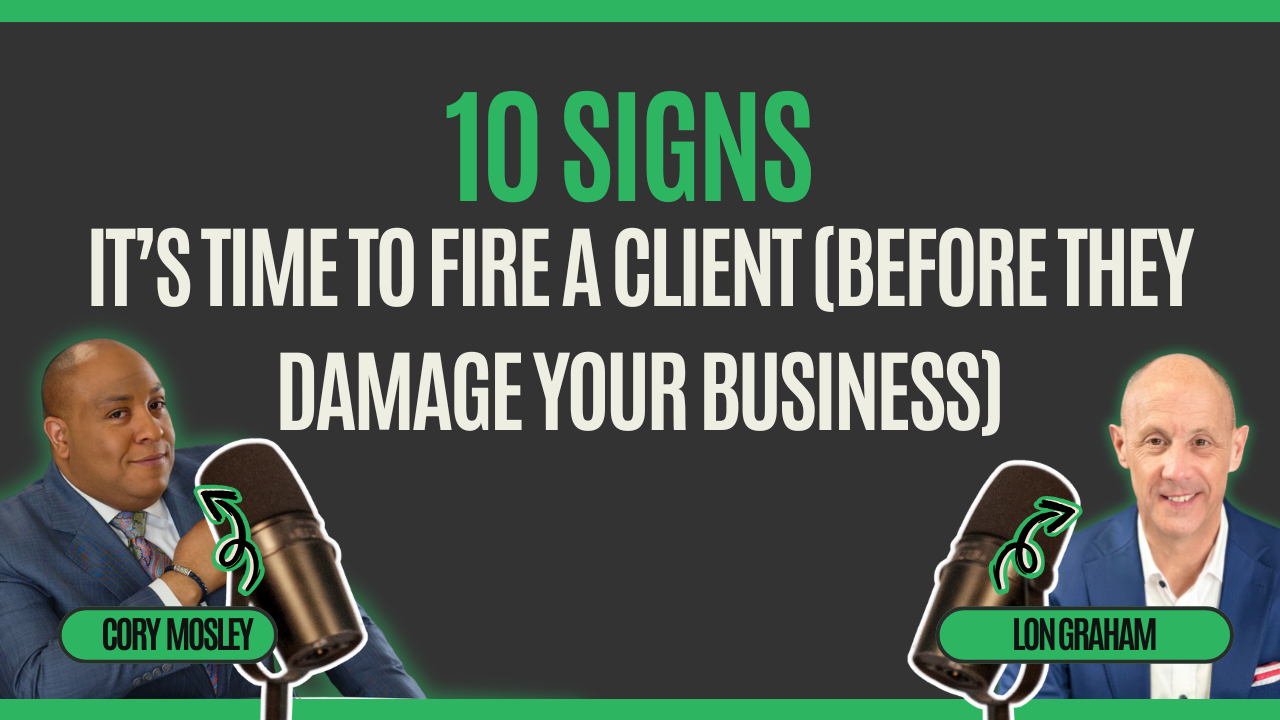
In this episode of the Grow Business Podcast, Cory Mosley and Lon Graham unpack 10 clear signs it’s time to fire a client — before they drain your energy, wreck your culture, and cost you serious growth.


Whether it’s constant “scope creep,” late payments, or ignoring your expertise, this conversation will help you stop making excuses and start making decisions that protect your peace and your profit.


Inside this episode:

  1. How to spot a "full-time job disguised as a part-time invoice
  2. The danger of clients who ignore boundaries (and your strategy)
  3. When toxic clients demoralize your team and kill your culture
  4. Why letting go of one bad client creates space for better ones
  5. How to use the "Three-Minute Client Test" to make the call
  6. What to consider before firing: revenue, contracts, and your reputation

Plus — real talk, strategic clarity, and a few candy-fueled mic drops 🍦

Plus: Sponsored by Pecan Jacks Ice Cream and Candy Kitchen—now franchising nationwide. With nearly $1M in average unit volume, this is a sweet opportunity you don’t want to miss. Learn more at pecanjacksfranchise.com.


Credits:

  • Hosted by: Cory Mosley, Business Growth Strategist
  • Co-Hosted by: Lon Graham, Voice of Reason
  • Produced by: Willie H.

Share Post

Similar Posts
By Cory Mosley February 18, 2026
In this episode of the Grow Business Podcast, Cory Mosley and Lon Graham unpack a truth most business owners learn the hard way: Strategic partnerships don’t fail because the idea was bad. They fail because the expectations were vague. And in 2026, vague is expensive. Everybody wants to “collaborate.” Everybody wants to “get in front of your audience.” Everybody wants to “partner.” But a partnership that isn’t tied to a clear business outcome isn’t strategy. It’s speculation. This conversation breaks down how to evaluate partnerships with the same discipline you’d use to evaluate a hire, an investment, or a market expansion—because that’s what partnerships are: a leverage play or a momentum killer. You don’t need more opportunities. You need better filters. In this episode: When to pursue partnerships: only with a clear growth objective A real partnership solves a specific growth problem. It accelerates revenue, expands reach, or builds credibility faster than you could do alone. If you can’t clearly define what it’s supposed to do for the business, it’s not strategic—it’s entertainment. And entertainment is expensive when you’re trying to grow. Defining success is the first principle of leadership Cory makes it plain: defining success is the number one principle for success in sales leadership . Because if you don’t define success, you can’t measure progress. And if you can’t measure progress, you can’t manage the partnership. Partnerships need KPIs, timelines, and a clear “win condition.” Otherwise you’re stuck in the most dangerous phrase in business: “Let’s just see what happens.” Avoid partnerships when roles, ownership, and control are vague Ambiguity feels friendly at the beginning. But it becomes expensive at the end. If decision-making authority isn’t defined, execution turns into friction. If ownership conversations keep getting avoided, the partnership becomes a slow-motion conflict you can see coming but don’t stop. And if you don’t talk about the exit before you start? You’ll eventually negotiate it while frustrated—and that’s when emotion gets expensive.
By Cory Mosley February 11, 2026
In this episode of the Grow Business Podcast, Cory Mosley and Lon Graham unpack a hard reality many business owners never see coming: success can become the most dangerous phase of growth . Not failure. Not competition. Not even the economy. The real threat in 2026 is believing that what made you successful will keep you successful. Markets don’t reward experience—they reward relevance . Customers don’t stop spending money in a down economy— who they spend it with changes . And your best year? That’s not a strategy. It’s a memory. This conversation is about identifying when confidence quietly turns into complacency, separating ego from execution, and redefining leadership for a faster, less forgiving market. If your business feels “stable” but not growing, this episode will challenge how you think about success. You don’t need to abandon your past wins. You need to stop letting them drive today’s decisions. In this episode: When confidence becomes complacency Past wins can create a false sense of immunity. Owners who’ve survived downturns often believe they’re untouchable—but ignoring early warning signs, dismissing new ideas, or saying “we’ve always done it this way” is how relevance erodes. Why your best year is not a growth plan Measuring performance against a past peak blinds you to current market conditions. Pricing, positioning, and buyer behavior have changed—and waiting for things to “go back” is how businesses stall out. The danger of tying your identity to the business When feedback feels personal, improvement stops. If your business can’t be questioned, it can’t be improved. Growth requires the ability to examine what’s broken without defending what’s familiar. Replacing ego-based decisions with evidence Instinct alone doesn’t scale. Customer behavior, retention, conversion, and attention matter more than opinions or legacy thinking. What worked before isn’t the question—what’s working now is. Redefining leadership for the 2026 market Leadership today isn’t about having all the answers. It’s about creating speed, clarity, and alignment—and building teams that challenge ideas instead of protecting egos. Winning leaders teach people how to think, not just what to do.
By Cory Mosley February 4, 2026
In this episode of the Grow Business Podcast, Cory Mosley and Lon Graham break down one of the most misunderstood drivers of small business growth: timing . Trends aren't just buzz—they're signals. The businesses winning market share today aren’t always the smartest. They’re the ones moving faster . Spotting early patterns. Acting before consensus. Testing before perfection. And turning ideas into offers before the crowd shows up. This conversation is about sharpening your awareness, upgrading your decisions, and taking proactive control of growth. If you’ve ever missed an opportunity because you waited “to see how it plays out,” this episode is your wake-up call. You don’t need to predict the future. You need to listen better , move quicker , and package smarter —starting now. In this episode: Why trend timing beats trend chasing If you're waiting on a report to confirm what your customers already told you, you're behind. Market share is captured in the gap between early awareness and mass adoption. How to build your “Trend Radar” Your next growth opportunity is already showing up—in customer complaints, requests, and unexpected purchases. You just haven’t systemized listening yet. The myth of going “all in” The best ideas don’t start as big bets. They start as small, fast experiments. 90-day sprints, soft rollouts, and test offers let you learn quicker and risk less. Turning trends into actual offers Buzz doesn’t convert—clarity does. It’s not about launching the next hot idea. It’s about simplifying decisions, selling the outcome, and showing how the trend helps your customer win. Why “consensus” is your enemy By the time everyone agrees a trend matters, the advantage is gone. Real leaders act on evidence, not certainty—and that’s where the edge lives.
More Posts